

Contribute in 6 steps
 How it works
Contribute in 6 steps
How the three draft outputs become texts adopted in Brussels: ITU sends the drafts to the three CoPs, each regulator answers on its own, each CoP meets and agrees one common position by 26 November, ITU merges the three positions, and Brussels negotiates and adopts the texts.
How your answers reach the texts adopted in Brussels
How each CoP coordinates
By email or in its sub-regional WhatsApp group
Between steps 2 and 4, members can coordinate their answers and agree the common position in two ways:
- Email: each member writes to its CoP chair, with ITU in copy.
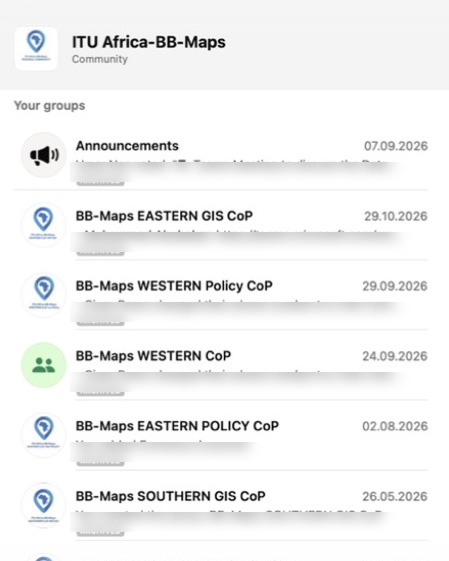
- WhatsApp: each CoP has its own sub-regional group (Western, Eastern, Southern) inside the ITU Africa-BB-Maps community, to agree dates, share drafts and prepare the CoP meeting.
The common position is always sent to ITU by email, by the chair, by 26 November.
Your six steps
ITU sends the three drafts to the CoPs
ITU sends the drafts to the three CoPs and their regional associations, with a short presentation in English and French on what Brussels is for: one common data standard, one Regional Community of Practice and a start on investment readiness. Read it with the three drafts below.
EN (PowerPoint) FR (PowerPoint)
One presentation per output, to share with your members: OUTPUT/1 OUTPUT/2 OUTPUT/3
Why it mattersAll members work from the same draft texts.
Investment Mapping and Prioritisation Guidance
- What it is
- A common way to use broadband maps to identify, rank and present investment needs.
- Why it matters
- A map only helps investors if it answers their questions: where coverage is missing, who is affected, what already exists nearby and what it would cost.
- What we ask you
- Which of the data financing institutions ask for are generally available in your sub-region, and where the main gaps are.
- Discussed in Brussels
- Monday 30 November
Common Data Standards and Data Sharing Framework
- What it is
- The minimum set of broadband data that all eleven countries would describe in the same way.
- Why it matters
- Without common definitions, national maps are difficult to compare and cross-border projects are difficult to assess.
- What we ask you
- For each feature of the Data Standardisation Package v1.0, fixed and mobile: what is collected by all eleven countries (regionally agreed), sub-regionally, nationally only or as an option, and how open it should be (public, partly available or private), at regional and at national level.
- Discussed in Brussels
- Tuesday 1 December
Charter and Work Programme 2027-2028
- What it is
- The rules of this Community and its plan for 2027-2028.
- Why it matters
- It keeps the work going after the programme ends in 2028, led by the region rather than by ITU.
- What we ask you
- How should the Community work together, and what should it prioritise in 2027? ITU merges the three CoP positions into the draft Charter and Work Programme.
- Discussed in Brussels
- Wednesday 2 December
What financing institutions need from a broadband map is taken from these sources; it is not asked of you.
- European CommissionBroadband Investment HandbookWhat public and private financiers look at before investing in a broadband network.Open ↗
- European CommissionBroadband mapping for effective investment and project planningThe four types of broadband maps (service, infrastructure, investment, demand) and how they guide public support.Open ↗
- ITUICT Infrastructure Business Planning ToolkitHow to build the business case for a broadband network.Open ↗
- ITUITU-D publicationsReports and guidelines on broadband policy, regulation and mapping.Open ↗
Your regional association briefs you
WATRA, EACO or CRASA sends the drafts and the questions to the regulators of its CoP, and sets the date for your answers.
Why it mattersEach CoP organises itself, in the way that works best for its members.
Answer individually and send to your CoP chair
Short answers to the questions in the drafts, for your authority, in English or French, with ITU in copy. No country figures are needed.
Why it mattersShort, general answers are enough.
Your CoP meets and agrees one common position
Your regional association holds a meeting of the CoP members, who agree one common position based on the needs of all; the chair sends it to ITU by 26 November.
Why it mattersThree positions reach ITU, one per CoP, each already agreed by its members.
ITU merges the three positions
Within 24 hours, ITU merges the three CoP positions into the drafts, noting where views differ, and publishes the consolidated drafts on the documents page.
Why it mattersIn Brussels you negotiate texts you have already seen and shaped.
Adoption in Brussels
Three days to negotiate and agree, one text per day, then adoption by consensus on Thursday 3 December.
Why it mattersThe adopted texts are the common reference for the Community’s work in 2027-2028.